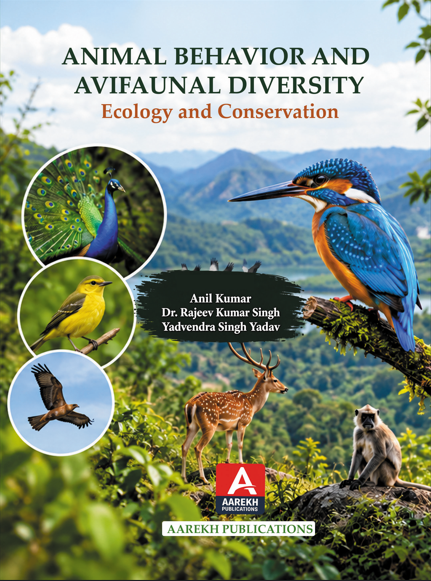
ANIMAL BEHAVIOR AND AVIFAUNAL DIVERSITY: Ecology and Conservation –
Home›Books›Edited Book›ANIMAL BEHAVIOR AND AVIFAUNAL DIVERSITY: Ecology and Conservation
ANIMAL BEHAVIOR AND AVIFAUNAL DIVERSITY: Ecology and Conservation
Author: Anil Kumar, Dr. Rajeev Kumar Singh, Yadvendra Singh Yadav
ISBN No: 978-81-68450-12-7
Type: Paperback
Page Number: 173
Publisher (INR): AAREKH PUBLICATIONS
The National Education Policy (NEP) 2020 calls for a fundamental shift in higher education toward multidisciplinary, competency-based, and experiential learning, away from rote memorisation of disconnected facts and toward the cultivation of critical thinking, scientific temper, and hands-on engagement with real-world problems. This book has been structured with these principles directly in view.
• Multidisciplinary framing: the subject matter draws explicitly on evolutionary biology, ecology, physiology, and environmental policy, reflecting NEP 2020's call to break down rigid disciplinary silos.
• Competency-based learning outcomes: each chapter opens with clearly stated learning outcomes, so that both instructors and students can assess what competencies, not merely what facts, the chapter is intended to build.
• Experiential and field-based learning: every chapter includes a Field/Activity-Based Exercise designed to take the learner beyond the printed page, whether through direct bird observation, use of citizen-science platforms, data interpretation exercises, or structured group discussion.
• Indian and local context: wherever possible, examples, species, habitats, and legal/policy frameworks are drawn from the Indian subcontinent, so that learners can connect global scientific principles to their own immediate environment.
• Formative self-assessment: chapter-end review questions are designed to support formative, competency-based self-assessment rather than rote recall alone, consistent with NEP 2020's broader assessment-reform philosophy.
Instructors adopting this book within an NEP 2020-aligned curriculum may wish to treat the Field/Activity-Based Exercises as graded or credit-bearing components of continuous, experiential assessment, in keeping with the policy's emphasis on holistic, skill-oriented evaluation.
 ×